
Frame rate and low light: are 60 fps ruining your deep shots?
There is a technical debate in the world of underwater filmmaking regarding the ideal frame rate to choose when light begins to fade. It is often suggested to use the lowest possible frame rate, such as 30 fps, as a way to avoid images excessively disturbed by digital noise caused by the necessary increase in ISO.
To clarify this aspect, I conducted a comparative test using two GoPro Hero 13 cameras in parallel during a dive at Sataya Reef (Fury Shoals, Egypt). The test was performed at seven in the morning, in relatively low ambient light conditions, comparing 30 and 60 frames per second (fps).
The first recording session took place at a depth of thirty meters on a soft coral (Dendronephthya hemprichi). Subsequently, I went deeper, exceeding forty meters—the limit for recreational diving—to film a tube sponge (Callyspongia crassa).
Analyzing the four resulting files, I did not notice any significant visual differences. To obtain objective confirmation, I subjected the clips to instrumental analysis using Neat Video software for digital noise control and Telemetry Extractor for second-by-second metadata reading.
Test at 30 meters depth
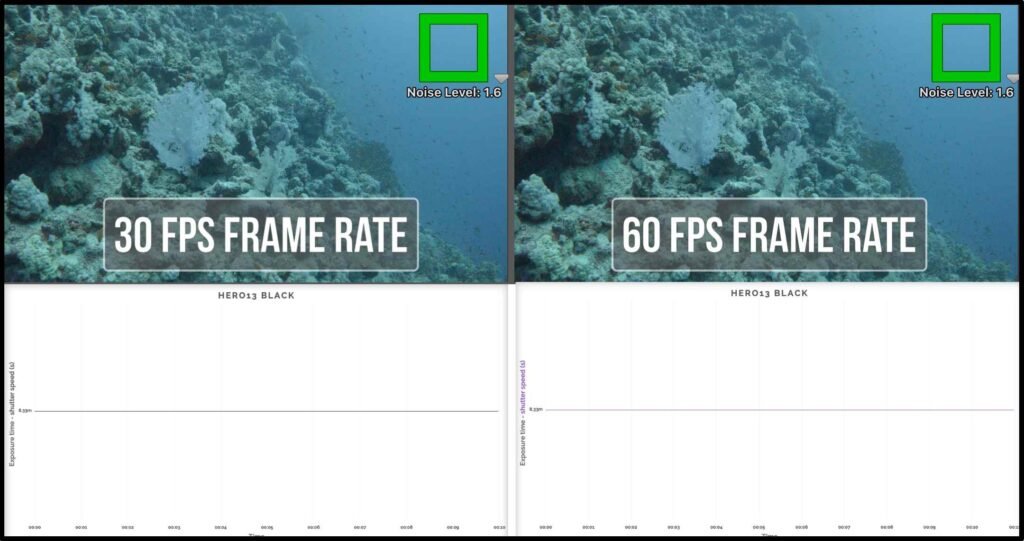
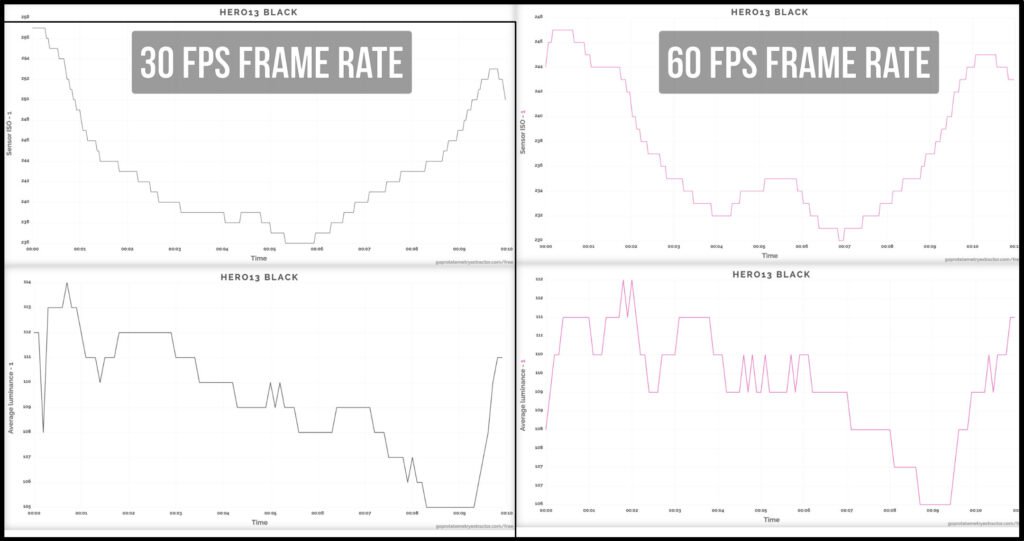
The digital noise level was identical for both files, settling at a moderate value of 1.6. Telemetry analysis revealed that the GoPro managed exposure similarly for both clips, setting a shutter speed of 1/120th of a second (8.33 milliseconds). ISO values also remained extremely close, ranging between 236 and 257 for 30 fps and 230 and 247 for 60 fps. A very interesting data point concerns the minimum brightness detected: 105 IRE for 30 fps and 106 IRE for 60 fps.
Test beyond 40 meters depth
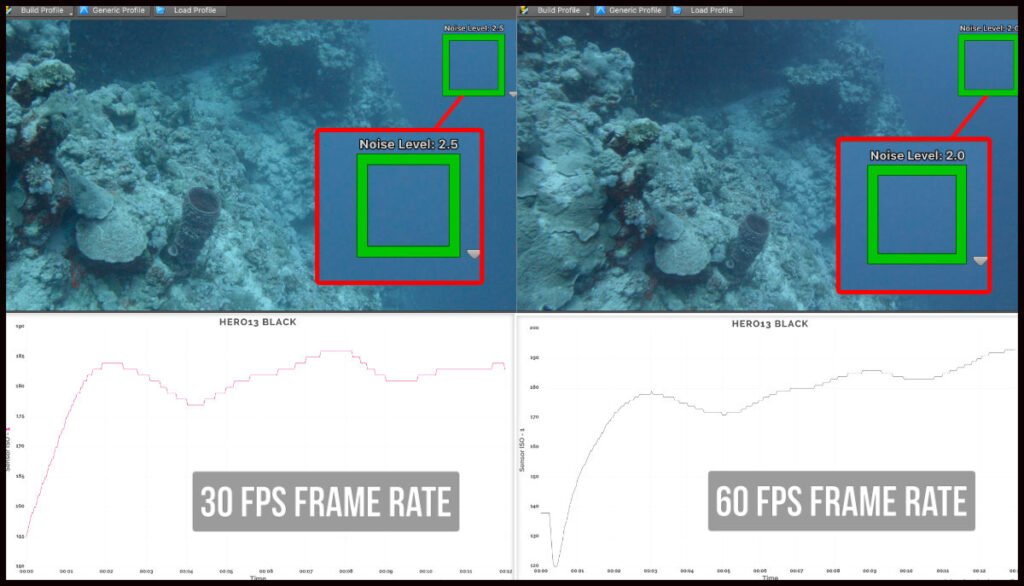
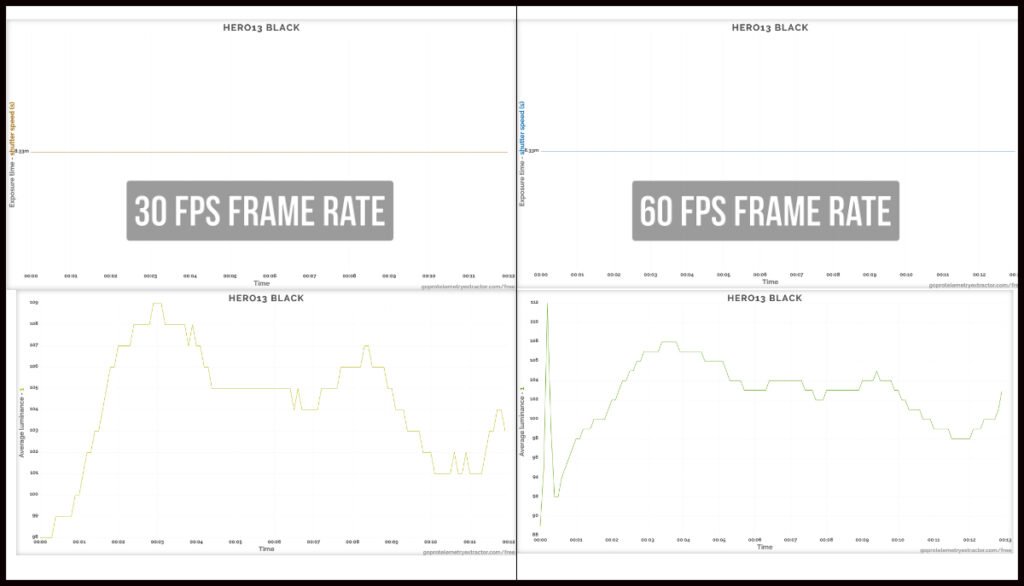
Using Neat Video, the digital noise level was unexpectedly higher for the 30 fps clip, reaching 2.5, while the 60 fps clip recorded a level of 2.0. Telemetry analysis showed that the GoPro again managed exposure consistently across both clips, maintaining a shutter speed of 1/120th of a second (8.33 ms). ISO values stayed stable at an average of 180, and the minimum detected brightness was also nearly identical between the two tests.
These data confirm that, within the limits of normal—even deep—daytime dives, using 60 frames per second does not penalize the footage. Having 60 frames per second available allows for extreme flexibility in post-production, providing the possibility to create smooth slow motion down to 50%. In conclusion, if the final goal is film processing, maintaining 60 fps proves to be a beneficial choice that does not affect the sensor’s performance compared to a lower frame rate.
To learn all the secrets of the GoPro Labs firmware, join GoPro Hacks. Here is just a preview of what you will find: Advanced GoPro Underwater Settings, the definitive guide with settings you won’t find anywhere else; GoPro Labs & Extensions, with diving configurations that almost no one knows; shooting techniques and post-production secrets, from the perfect capture in the blue to creating a cinematic look.
Join now to discover all the content and start transforming your videos!