
Filming the Oceanic Whitetip Shark
The oceanic whitetip shark (Carcharhinus longimanus), also known as the longimanus shark, is a pelagic species primarily observed in areas where the coral reef drops sharply into great depths. Indeed, its most frequent appearances occur in renowned locations of the Egyptian Red Sea, such as the Brothers Islands, Daedalus Reef, and Elphinstone Reef.
This shark is considered potentially dangerous for divers because its curious and bold behavior leads it to approach without fear, showing an attention that can evolve into more persistent investigation and, in some rare cases, an attack.
In the Red Sea, the Longimanus is indeed sadly known for several past incidents that have caused serious injuries or fatalities to divers and snorkelers. Attacks often occurred near the surface and, at first glance, appeared unprovoked (meaning the victim did not attempt to touch, feed, or threaten the shark). However, video footage suggests that the divers’ behavior was not always entirely appropriate.
For example, in 2018 at the Brothers, an attack occurred that, fortunately, did not have serious consequences: a diver swam towards the boat’s ladder with their back to the animal, despite the presence of a particularly curious and agitated shark.. [Link to video]
Also in 2018, again at the Brothers, a much more critical episode was recorded: the video shows divers scattered, with unstable buoyancy, producing many bubbles. Some constantly move their arms, and others wear shorty wetsuits, which are absolutely unadvisable in waters frequented by potentially dangerous sharks. And, despite several previous attack attempts, the divers remained immobile, failing to react correctly, such as regrouping with their backs to the reef. One of them, who later had a limb amputated, was bitten while remaining in a horizontal position and not facing the animal. [Link to video]
In another episode, one of the most risky behaviors is seen: divers turning their backs on the shark and even petting it, probably mistaking it for a pet. [Link to video]
According to experts, in some circumstances, the longimanus can interpret human presence as a possible food source, especially if food is thrown from boats. Proof of this is the fact that, after closing the Brothers Islands for several months and definitively prohibiting boats from spending the night there, no further attacks have been reported.
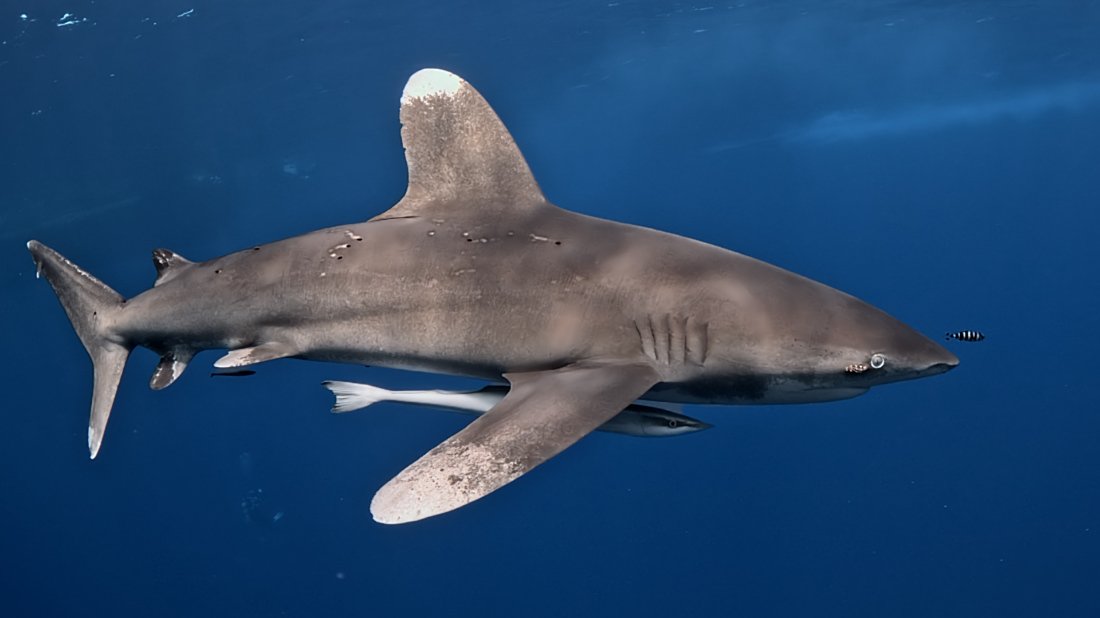
Filming the Oceanic Whitetip responsibly
Diving on liveaboards in the most renowned sites of the Red Sea makes filming the oceanic whitetip relatively straightforward. The real challenge, however, lies in doing so without capturing thousands of bubbles or enthusiastic divers trying to chase it.
When I dive with the intention of filming these sharks, I always strive to maintain a sufficient air supply for the final phase of the dive. I wouldn’t want to be forced to ascend prematurely, right at the most interesting moment of the action, simply because I’m on reserve. I also avoid descending too deeply, preferring to stay at depths that would allow, in case of a sighting, a rapid ascent to the surface.
A crucial element is weighting: as these are often “end-of-dive” shots and with aluminum tanks, it’s important to wear adequate weight to be able to hold your breath for several seconds, while maintaining good buoyancy, even at shallow depths.
The dive buddy must possess the same skills and experience, as synergy is essential for this type of filming. Indeed, when the shark is spotted (and usually pursued) by the group, it will be necessary to discreetly peel away with calm fin kicks, to position oneself along what is predicted to be its trajectory. Attempts to follow it with the rest of the group are to be avoided, as they would only yield distant shots of its tail and many bubbles.
Subsequently, it’s appropriate to simply wait, maintaining harmonious buoyancy and measured breathing, in order to produce as few bubbles as possible. If one manages to be “clean” – that is, not to disturb the animal – its healthy curiosity can be aroused. This will first encourage the shark to position itself at our same depth, then make a frontal approach, and finally a lateral pass, almost in slow motion: the ideal moment for filming.
Disturbing and provoking the shark, causing aggressive behaviors such as nose bumps, spasmodic circling around the diver, or rapid and frantic ascents and descents, is absolutely to be avoided. Although such behaviors might produce spectacular footage, they are in reality signals of an incorrect interaction with the animal and a prelude to an incident. Sometimes, however, these episodes are also triggered by previous interactions with less responsible divers.
Always avoid following the shark all the way to the surface: you risk skipping your safety stop, but even more importantly, at the water’s surface, it is much harder to fend off a potential attack.
Filming the Oceanic Whitetip responsibly
Diving on liveaboards in the most renowned sites of the Red Sea makes filming the oceanic whitetip relatively straightforward. The real challenge, however, lies in doing so without capturing thousands of bubbles or enthusiastic divers trying to chase it.
When I dive with the intention of filming these sharks, I always strive to maintain a sufficient air supply for the final phase of the dive. I wouldn’t want to be forced to ascend prematurely, right at the most interesting moment of the action, simply because I’m on reserve. I also avoid descending too deeply, preferring to stay at depths that would allow, in case of a sighting, a rapid ascent to the surface.
A crucial element is weighting: as these are often “end-of-dive” shots and with aluminum tanks, it’s important to wear adequate weight to be able to hold your breath for several seconds, while maintaining good buoyancy, even at shallow depths.
The dive buddy must possess the same skills and experience, as synergy is essential for this type of filming. Indeed, when the shark is spotted (and usually pursued) by the group, it will be necessary to discreetly peel away with calm fin kicks, to position oneself along what is predicted to be its trajectory. Attempts to follow it with the rest of the group are to be avoided, as they would only yield distant shots of its tail and many bubbles.
Subsequently, it’s appropriate to simply wait, maintaining harmonious buoyancy and measured breathing, in order to produce as few bubbles as possible. If one manages to be “clean” – that is, not to disturb the animal – its healthy curiosity can be aroused. This will first encourage the shark to position itself at our same depth, then make a frontal approach, and finally a lateral pass, almost in slow motion: the ideal moment for filming.
Disturbing and provoking the shark, causing aggressive behaviors such as nose bumps, spasmodic circling around the diver, or rapid and frantic ascents and descents, is absolutely to be avoided. Although such behaviors might produce spectacular footage, they are in reality signals of an incorrect interaction with the animal and a prelude to an incident. Sometimes, however, these episodes are also triggered by previous interactions with less responsible divers.
Always avoid following the shark all the way to the surface: you risk skipping your safety stop, but even more importantly, at the water’s surface, it is much harder to fend off a potential attack.
Even if shots are almost always taken near the surface, for white balance it is preferable to use the automatic setting, as seen in the first video illustrating the approach technique described earlier. In the second video, the white balance was set to 5500K, a value I typically use for surface shots, and even with careful post-production, I couldn’t achieve the desired results.
Especially when filming the oceanic whitetip, correct positioning is of fundamental importance and must be prepared already during the approach phase. The sun should be behind the diver, and it is essential to avoid including other divers and bubbles in the frame.
Should you wish to post on social media in a 9:16 format, it is advisable to avoid overly close-up shots. In the absence of an accessory wide-angle lens, these frames risk blurring and, in any case, make it difficult to position the shark effectively within the vertical format.